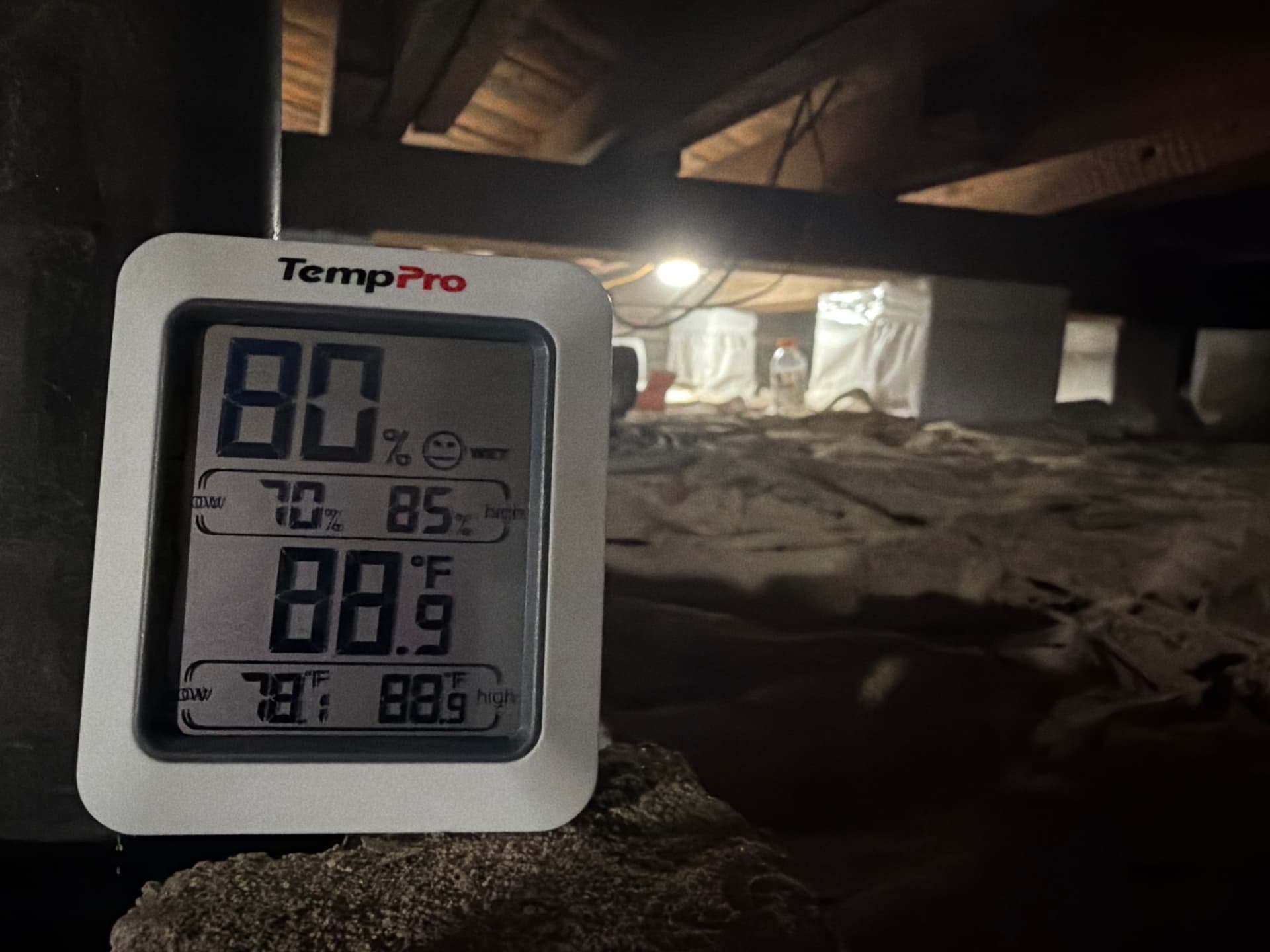
Here's what we were working with first thing in the morning at a home in East Hill - 80% relative humidity and 88.9 degrees Fahrenheit sitting right underneath the living space. That's not a crawl space, that's a sauna. And it hadn't even hit 7am yet.
Numbers like that don't stay below the floor. Moisture at those levels works its way up into the subfloor, the framing, and eventually into the air you breathe inside your home. That's how you end up with soft spots in your floors, musty smells that won't go away, and mold quietly taking hold where you can't see it.
This is exactly why we do a full crawl space encapsulation on jobs like this. We're sealing the space off from ground moisture with a heavy-duty vapor barrier, locking out the humidity that would otherwise just keep cycling through. It's a complete approach to moisture remediation - not a patch job.
A lot of homeowners don't think about their crawl space until something obvious goes wrong. But by the time your floors feel damp or you notice an odor, the damage has usually already started. Catching it early - and solving it properly - is what protects the structure of the home long-term.
The Gulf Coast climate is brutal on crawl spaces. High heat and humidity are the norm down here, and homes in neighborhoods like East Hill deal with it every summer. Encapsulation paired with proper moisture remediation is one of the most protective things you can do for a home in this region.